
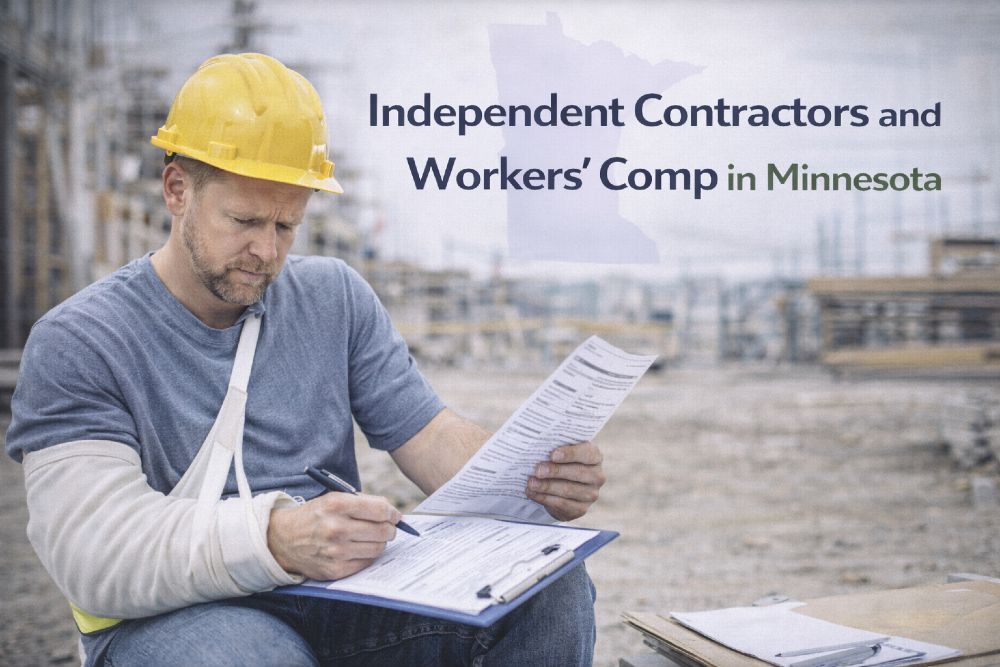
Independent Contractors and Workers’ Comp in Minnesota
Quick answer: Being labeled an “independent contractor” does not automatically disqualify you from Minnesota workers’ compensation. True independent contractors are generally not covered, but many workers are misclassified — treated as contractors on paper while functioning as employees in practice. Minnesota looks past job titles and 1099s to the real working relationship, weighing factors such as how much control the company has over the work, who supplies tools and equipment, how the worker is paid, and whether the work is part of the company’s regular business. If a misclassified worker is actually an employee under the law, workers’ compensation benefits may still be available after a work injury.
It is one of the most discouraging things an injured worker can hear: “You’re a contractor, so you’re not covered.” Many people accept that answer and never pursue a claim. But in Minnesota, the label a company puts on you is not the final word. Misclassification is common — especially in construction, trucking, delivery, and gig-based work — and the law is designed to look at what actually happened on the job, not just what a contract says.
This article explains how Minnesota workers’ compensation law evaluates independent contractor status, why misclassification happens, and when an injured worker who was called a contractor may still qualify for benefits.
Are Independent Contractors Covered by Workers’ Compensation in Minnesota?
As a general rule, genuine independent contractors are not covered by an employer’s workers’ compensation insurance, because coverage under Minnesota Statutes Chapter 176 flows to employees. The catch is that whether someone is truly an independent contractor is a legal question, not just a matter of what the paperwork says.
Many workers are classified as contractors even though, day to day, they are directed and controlled like employees. When that happens, the worker may be misclassified — and a misclassified worker who is actually an employee under Minnesota law may still be entitled to workers’ compensation benefits after a work injury. The Minnesota Department of Labor and Industry (DLI) administers the workers’ compensation system and treats worker misclassification as a serious issue.
Minnesota workers’ compensation lawyer
How Does Minnesota Determine Independent Contractor Status?
Minnesota does not decide the question based on a contract title alone. Instead, the analysis looks at the substance of the relationship, with the right to control the work generally treated as the most important consideration. Factors that are commonly weighed include:
- Control over how the work is done — does the company direct the methods, schedule, and details, or just the end result?
- Who supplies tools, equipment, and materials — the worker or the company?
- Method of payment — regular wages by the hour or week, versus payment by the job or project
- Whether the work is part of the company’s regular business — core, ongoing work points toward employment
- The right to discharge — whether the company can fire the worker at will
- Whether the worker can refuse assignments or work for others — genuine independence versus economic dependence on one company
- The duration and permanence of the relationship — an ongoing arrangement looks more like employment than a one-off engagement
No single factor is automatically decisive. A worker can be paid on a 1099, sign a contract calling them an “independent contractor,” and still be found to be an employee if the overall relationship looks like employment. It is worth noting that Minnesota applies specific statutory tests in certain industries — construction is a notable example, where the rules for who counts as an independent contractor are especially detailed. Because of this, classification in the building trades is frequently disputed.
Why Is Misclassification So Common in Certain Industries?
Worker misclassification shows up most often in construction, trucking, warehouse and delivery work, and gig-based jobs. Sometimes it is a genuine misunderstanding of the rules. Often, though, it is a cost decision: classifying workers as contractors can let a business avoid paying workers’ compensation premiums, payroll taxes, and other employee costs.
Whatever the motivation, the effect on an injured worker is the same — a claim gets denied at the door on the basis of a label. Construction is a particularly high-stakes example because the work is dangerous and the classification rules are strict. Our guide to construction work injuries and workers’ comp in Minnesota covers how jobsite claims are handled once employment status is established.
What Happens If You Are Injured While Misclassified?
If you are hurt while classified as an independent contractor, it is common for the claim to be denied initially — the insurer or employer will often point to the contractor label as the reason. That denial is not necessarily the end of the matter.
These disputes are frequently challenged by looking at the actual working relationship rather than the title. Evidence that can matter includes who set your schedule, who supplied your tools, whether you were told exactly how to do the work, whether you worked mainly for one company, pay records, text messages and emails with a supervisor, and testimony about how the job really operated. If you have received a denial, our page on what to do if your workers’ comp claim is denied in Minnesota explains how the dispute process may move forward.
How Do Insurance Companies Use Independent Contractor Status as a Defense?
Contractor status is one of the more common defenses insurers raise to avoid paying workers’ compensation benefits, particularly in higher-cost injury cases. By framing the injured person as a non-employee, the insurer aims to sidestep coverage entirely rather than dispute the medical facts.
This is one of several strategies used to limit or deny benefits. To recognize the broader pattern, see our overview of insurance company tactics in workers’ comp claims. The same classification argument can also surface as a reason an employer gives after firing an injured worker — our page on being fired for filing workers’ comp in Minnesota discusses that scenario.
What Benefits May Be Available If You Are Found to Be an Employee?
If a worker is determined to be an employee under Minnesota law, the same workers’ compensation benefits available to any injured employee may apply, including:
- Reasonable and necessary medical treatment for the work injury
- Wage-loss benefits when the injury limits the ability to work or earn
- Permanent disability compensation for lasting impairment
- Vocational rehabilitation or retraining if returning to the same job is not realistic
For a full breakdown of each category, see workers’ compensation benefits in Minnesota.
When Should You Talk With a Minnesota Workers’ Compensation Lawyer?
Legal guidance can be especially important in independent contractor cases, because classification disputes are fact-intensive and the initial denial can feel final even when it is not. An attorney can help evaluate your true employment status, gather evidence about how the work actually operated, and address disputes under Minnesota workers’ compensation law. If you were told you are not covered simply because you were called a contractor, it may be worth having that conclusion reviewed. Many workers’ compensation attorneys offer a free initial consultation.
Workers’ compensation lawyer in Minnesota
Frequently Asked Questions
I received a 1099 — does that mean I can’t get workers’ comp in Minnesota?
Not necessarily. A 1099 and a contract calling you an independent contractor are relevant, but they are not decisive. Minnesota looks at the real working relationship — control over the work, who supplied tools, how you were paid, and whether the work was part of the company’s regular business. If those facts point to employment, benefits may still be available despite the 1099.
What is the most important factor in deciding contractor versus employee?
The right to control the work is generally treated as the most significant factor — whether the company directs how, when, and in what manner the work is performed, rather than just the final result. However, the determination weighs the overall relationship, so other factors like tools, payment method, and permanence also matter.
Why did my claim get denied because of my classification?
Insurers and employers sometimes deny a claim by pointing to a contractor label, especially in higher-cost cases, because it lets them argue there is no coverage at all. A denial on that basis can often be challenged by showing that the actual working relationship was that of an employee.
Is misclassification common in construction and trucking?
Yes. Construction, trucking, warehouse, and delivery work are among the industries where misclassification is most frequently seen. Construction in particular has detailed Minnesota rules for who qualifies as an independent contractor, which is one reason classification is so often disputed in the building trades.
What evidence helps prove I was really an employee?
Helpful evidence may include who set your schedule and directed your work, who provided tools and equipment, pay records, whether you worked primarily for one company, and communications with supervisors showing day-to-day control. The overall picture of how the job actually operated is usually more important than any single document.
Get Help After a Work Injury as a Classified Contractor
If a work injury happened while you were classified as an independent contractor, speaking with a lawyer may help clarify whether workers’ compensation benefits are still available in your situation. Request a free consultation.
Independent contractors who use motorcycles or other vehicles as part of their work may also have questions about personal injury claims against at-fault third parties, which operate separately from the workers’ compensation system. Our overview of motorcycle accident injury claims in Minnesota explains how those claims generally work.
Even if workers’ comp is not available to you as an independent contractor, you may still have a third-party claim against an at-fault driver if you were injured in a vehicle accident on the job. Learn more: Work-Related Motor Vehicle Accidents — Workers’ Comp & Third-Party Claims in Minnesota.
Disclaimer: This article is intended for general informational and educational purposes only and does not constitute legal advice. Worker classification and workers’ compensation matters are fact-specific, and outcomes depend on the actual working relationship, medical evidence, and applicable Minnesota law. Reading this article, or contacting the firm, does not create an attorney-client relationship. If you have questions about your own situation, please consult a licensed Minnesota attorney.